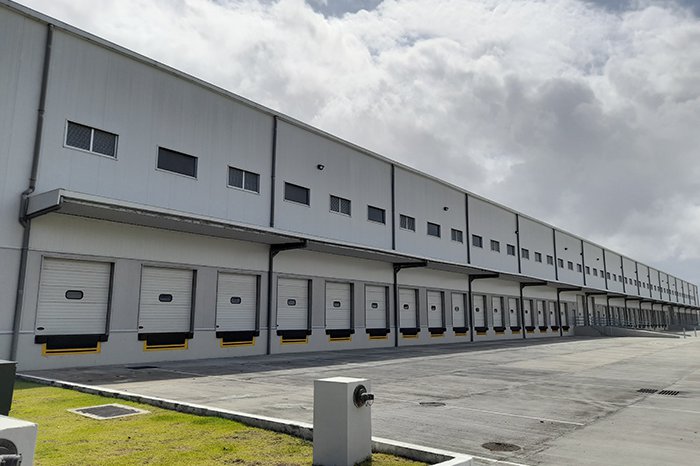
The short answer. The Colón Free Zone is a walled trade area beside Panama's Atlantic ports where goods come in, are stored and reworked, and leave again without paying Panama's import duties or taxes. To operate inside it, a company needs its own operating key from the zone. If you only need your goods stored, consolidated and re-exported, a licensed warehouse beside the zone does the same job. It is outside the zone, so the operating key does not apply.
What the Colón Free Zone is
- Where: in the city of Colón, on Panama's Caribbean coast, near the Atlantic entrance of the Canal. The zone describes itself as minutes from the Atlantic cargo ports. Panama's investment agency puts it 45 minutes from Panama City.
- Size: 1,064.5 hectares, by the zone's own figure.
- Legal basis: created in 1948 and governed today by Law 8 of 2016, amended in 2023. It is run by the Zona Libre de Colón, an institution of the Panamanian State.
- What it is for: the zone describes itself as a regional distribution center for Central America, the Caribbean and beyond.
What you can do there
The law lets companies in the zone bring in, store, display, pack, repack, split shipments, label, assemble and mix goods, and re-export them. Other activities, such as logistics services for third parties, have to be enabled on the company's operating key.
Trade in the zone is wholesale. Retail shops are not allowed inside it. Companies already established there can add a regulated channel for online sales to final consumers.
Taxes and duties
- Goods are free of import duties and other taxes when they enter the zone, while they stay, and when they are re-exported.
- Goods that are re-exported are never imported into Panama.
- Goods sold into Panama are imported at that point. Import duties and ITBMS, Panama's 7% transfer tax, apply to what enters the country.
- A company's income from re-export abroad is exempt from income tax. Income from customers in Panama is taxed under the general rules.
What it takes to operate there
The zone lists four ways to establish yourself, and each needs an operating key, which the zone lists at USD 2,500 a year:
- User company: a contract with the zone, with an operating permit the zone lists at USD 2,400 a year and a guarantee deposit of USD 5,560.
- Lease of premises or a lot: rent by area, with a deposit of three months.
- Represented company: a foreign company not established in Panama is represented by a company already in the zone, under a representation agreement. The law limits this route to re-export.
- Public warehouse: storage in the zone's public warehouse.
Sector permits, such as health or security permits, still apply to the goods you handle. If you plan to set up your own company in the zone, take legal and tax advice first.
How goods move
- Each entry and exit is recorded on an electronic movement declaration, connected to the customs system.
- In 2026, customs introduced its own re-export declaration for cargo leaving the zone, on top of the zone's declaration.
- Goods can be transferred to companies in Panama's other special zones.
- Goods can be sold into Panama once the import duties and taxes are paid.
The route beside the zone: a licensed warehouse, with no operating key
Not every company that uses Colón needs to be inside the zone.
Our Colón warehouse is at Colón Logistics Park, inside the Colon Container Terminal port area and beside the Colón Free Zone. The park is not part of the zone, so the zone's operating key does not apply there. Our warehouse operates under Panama's customs logistics warehouse regime (Depósito Aduanero Logístico, or DAL), which is authorised and supervised by the National Customs Authority (ANA). The authorisation covers the warehouse, so you do not apply for a licence of your own.
- Your goods are stored tax- and duty-free, by pallet or in bulk. Panama's DAL decree exempts foreign goods from duties and customs charges until they are imported into Panama or moved to another customs regime.
- Goods can stay for three years, extendable by three more with the customs authority's approval.
- We deconsolidate containers, consolidate shipments from several suppliers, and assemble, kit, relabel and inspect goods before they ship on.
- Your goods keep their origin status while they are stored, and re-export certificates can be issued under Panama's trade agreements.
- We re-export by sea, air and ground. Miami is 3 days away by full container.
- If you also sell in Panama, you import only what you sell there.
Inside the zone or beside it, side by side
Both routes hold goods free of Panama's duties and taxes, beside the Atlantic ports. They differ in what you have to set up and who does the work.
Regulated by
- Inside the zone: the Colón Free Zone administration.
- With Yaca, beside the zone: the National Customs Authority (ANA).
Licence
- Inside the zone: your own operating key from the zone, listed at USD 2,500 a year.
- With Yaca, beside the zone: no operating key. The key is a Colón Free Zone requirement and does not apply at Colón Logistics Park. The customs authority's authorisation covers the warehouse, so you do not apply for a licence of your own.
Setting up
- Inside the zone: a contract or a lease with the zone, or a representation agreement with a company already there.
- With Yaca, beside the zone: no contract with the zone. Your goods come into our warehouse.
Fixed costs to get started
- Inside the zone: the key each year. A user company adds an operating permit listed at USD 2,400 a year and a guarantee deposit of USD 5,560, plus rent for its premises and its own staff.
- With Yaca, beside the zone: none of the zone's charges apply. We quote storage and handling for your operation.
Premises and staff
- Inside the zone: your own premises and staff in the zone, or those of the company that represents you.
- With Yaca, beside the zone: our warehouse and our team do the work.
Paperwork for each movement
- Inside the zone: each of your company's entries and exits goes on an electronic movement declaration, and re-exports also need a customs re-export declaration.
- With Yaca, beside the zone: our team handles the paperwork for every entry and exit.
Duties and taxes
- Inside the zone: none on entry, during storage or on re-export.
- With Yaca, beside the zone: your goods are stored tax- and duty-free, until they are imported into Panama or moved to another customs regime.
How long goods can stay
- Inside the zone: the zone's law sets no time limit.
- With Yaca, beside the zone: three years, extendable by three more with the customs authority's approval.
Selling
- Inside the zone: wholesale from your own premises in the zone, with goods on display.
- With Yaca, beside the zone: you sell from wherever you are and we ship: re-export by sea, air and ground, or into Panama once the goods are imported.
On either route, goods you sell into Panama are imported at that point, and import duties and ITBMS apply to what enters the country.
Which route fits
Operating inside the Colón Free Zone usually fits if you:
- Want your own premises and staff in the zone.
- Display goods and sell wholesale from the zone.
- Want a company of your own in the zone, with the zone's income-tax treatment for re-export sales.
A licensed warehouse beside the zone usually fits if you:
- Need storage, consolidation and re-export, without setting up in the zone or applying for its operating key.
- Want to test the route with one shipment before committing to more.
- Want freight, customs paperwork and storage handled by one team.
Questions companies ask
Do goods in the Colón Free Zone pay import duties?
No, not while they stay in the zone. If they are re-exported, they are never imported into Panama.
Can a foreign company use the zone without a company in Panama?
The law allows a foreign company to be represented by a company established in the zone, for re-export only. It still needs a representation agreement and a key of its own, which the zone lists at USD 2,500 a year.
Can I sell into Panama from the zone?
Yes. Goods sold into Panama are imported at that point, and import duties and ITBMS apply to what enters the country.
Is retail allowed in the Colón Free Zone?
No. Retail shops are not allowed inside the zone. Established companies can use a regulated channel for online sales to final consumers.
What is the difference between the Colón Free Zone and Colón Logistics Park?
The Colón Free Zone is a free trade zone where each company operates with its own key. Colón Logistics Park is in the Colon Container Terminal port area, beside the zone, and the zone's operating key does not apply there. Our warehouse at the park operates under the customs logistics warehouse regime (DAL), authorised by the National Customs Authority, and your goods are stored tax- and duty-free.
Do I need an operating key to store goods with Yaca in Colón?
No. The operating key is a Colón Free Zone requirement. Our warehouse is at Colón Logistics Park, beside the zone, where it does not apply. The customs authority's authorisation covers the warehouse, and our team handles the paperwork.
How long can goods stay in a customs logistics warehouse (DAL)?
Three years, extendable by three more with the customs authority's approval. The Colón Free Zone's law sets no time limit.
Related guide: Colón Free Zone or Panamá Pacífico: which fits your operation?
Tell us what you sell and where it has to go. We set up a call to go through the details, then send the plan and the price.
Request a quote
Sources (checked November 2026)
- Zona Libre de Colón, official site: who we are, how to establish a company, benefits (zolicol.gob.pa)
- Law 8 of 4 April 2016, which reorganises the Colón Free Zone, with the changes of Law 412 of 2023
- PROPANAMA, Ministry of Commerce and Industries: Colón Free Zone (propanama.mici.gob.pa)
- Cabinet Decree 10 of 27 April 2021, which creates the customs logistics warehouses (Depósitos Aduaneros Logísticos), with the changes of Cabinet Decree 13 of 11 March 2025