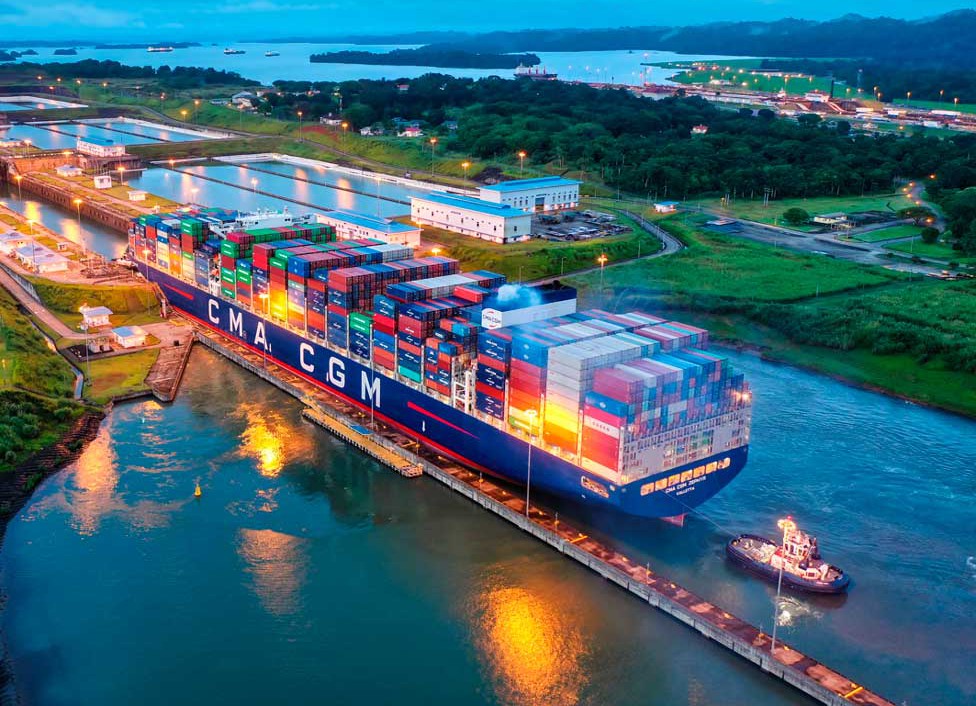
The short answer. Both zones let you hold goods in Panama without paying import duties or taxes until the goods enter the Panamanian market. The difference is where they are and what they are built for. The Colón Free Zone sits beside the Atlantic ports and is built for redistribution: goods arrive in volume and are re-exported across the region. Panamá Pacífico sits at the Canal's Pacific entrance, next to Panama City, and mixes logistics with assembly, manufacturing and services. Most companies choose by where their cargo arrives and where it has to go next.
What the two zones have in common
- Goods enter free of import duties and of ITBMS, Panama's 7% transfer tax, and stay free of both while they are stored.
- Goods that are re-exported are never imported into Panama.
- Goods sold into Panama are imported at that point. Import duties and ITBMS apply to what enters the country, and the customs declaration is filed by a licensed customs broker.
The Colón Free Zone: the rules in brief
- Where: on the Caribbean coast, at the Atlantic entrance of the Panama Canal, beside the country's Atlantic ports.
- Legal basis: created in 1948 and governed today by Law 8 of 2016, amended in 2023. It is run by the Zona Libre de Colón, an institution of the Panamanian State.
- What it is for: the zone describes itself as a regional distribution center. Companies import, store, repack and re-export, mostly wholesale. Retail shops are not part of the zone.
- Control: goods move in and out under electronic movement declarations, and a customs declaration for re-exports was introduced in 2026.
- Setting up your own company there: you need an operating key from the zone's administration, which the zone lists at USD 2,500 a year, plus premises. The law also lets a foreign company be represented by an established one, for re-export only, and that route needs a key as well.
Panamá Pacífico: the rules in brief
- Where: in Arraiján, on the west bank of the Canal at its Pacific entrance. The developer puts it 13 km from downtown Panama City and 5 km from the Pacific-side port at Rodman.
- Legal basis: Law 41 of 2004 created the Panamá Pacífico Special Economic Area. It is overseen by the Agencia Panamá Pacífico, a State agency, and built out by a private master developer.
- What it is for: a mixed area. Logistics and distribution sit beside high-technology manufacturing and assembly, aviation and maritime services, and corporate offices. It also includes housing, schools and shops.
- Control: customs oversight relies on inventory audits of the companies registered in the area.
- Setting up your own company there: you register with the agency, which lists a USD 2,500 registration payment, and you need a contract for space in the area.
Company tax treatment in both zones depends on the activity and has changed several times since 2016. If you plan to set up your own company in either zone, take tax advice first. If you only need your goods stored, handled and shipped, you do not need to.
Which one fits
Colón usually fits if your operation:
- Receives containers from Asia or the United States and redistributes by sea to Central America and the Caribbean.
- Ships to and from the US East Coast and Miami.
Panamá Pacífico usually fits if your operation:
- Re-exports by road to Costa Rica and Central America. Panamá Pacífico's entrance is on the Pan-American Highway, on the west side of the Canal, so trucks are on the road to Central America from the gate.
- Assembles, configures or kits products before sending them on.
- Stores machinery between project phases.
- Stores controlled chemical substances.
- Supplies vessels at the Pacific end of the Canal.
If it does several of these, use both, with stock split between them.
Holding goods in Panama without setting up your own company
Inside the Colón Free Zone, a company needs its own operating key. There are two ways to hold goods tax- and duty-free in Panama without one, and Yaca offers both.
- Our Colón warehouse is at Colón Logistics Park, inside the Colon Container Terminal port area and beside the Colón Free Zone. It operates under Panama's customs logistics warehouse regime (Depósito Aduanero Logístico, or DAL), which is authorised and supervised by the National Customs Authority (ANA). The authorisation covers the warehouse, so you do not need an operating licence of your own, and you do not have to file a declaration for each movement in and out. We store by pallet and in bulk, tax- and duty-free, for up to three years, extendable by three more with the customs authority's approval. We consolidate and re-export. Miami is 3 days away by full container.
- In our Panamá Pacífico warehouse, you do not need a company of your own in the area. We store pallets, bulk cargo and machinery, about 20 minutes from Panama City, and we assemble, configure and kit products before they ship on. The warehouse is licensed by CONAPRED for controlled chemical substances.
- In both, you import into Panama only what you sell there. Our team prepares each entry, exit and re-export, and licensed customs brokers file the declarations.
Questions companies ask
Is one zone cheaper in duties than the other?
No. In both, goods are free of import duties and ITBMS while they are stored, and both apply when goods enter Panama.
Do I need my own company or licence to store goods in Panama?
Inside the Colón Free Zone, yes: you need your own operating key. At Yaca's Colón warehouse, beside the zone and under the DAL regime, you do not. In Panamá Pacífico, you need no company of your own when you store with Yaca.
Can I sell into Panama from either zone?
Yes. Goods released to the Panamanian market are imported at that point, and duties and taxes apply only to what you bring into the country.
Can I use Colón and Panamá Pacífico together?
Yes. You can keep stock for redistribution by sea in Colón and stock that moves by road to Central America, or goods that need work, in Panamá Pacífico. With Yaca, one team runs both warehouses.
Which is closer to Panama City?
Panamá Pacífico. It is across the Canal from the capital. Colón is on the opposite coast.
Related guide: How the Colón Free Zone works: a guide for importers and re-exporters
Tell us what you sell and where it has to go. We set up a call to go through the details, then send the plan and the price.
Request a quote
Sources (checked November 2026)
- Zona Libre de Colón, official site: zolicol.gob.pa
- Law 8 of 4 April 2016, which reorganises the Colón Free Zone, with the changes of Law 412 of 2023
- Agencia Panamá Pacífico, official site: app.gob.pa
- Law 41 of 20 July 2004, which creates the Panamá Pacífico Special Economic Area
- Panamá Pacífico developer site, for the distances quoted: panamapacifico.com
- Dirección General de Ingresos, tax incentives for the Panamá Pacífico area: dgi.mef.gob.pa
- Cabinet Decree 10 of 27 April 2021, which creates the customs logistics warehouses (Depósitos Aduaneros Logísticos), with the changes of Cabinet Decree 13 of 11 March 2025